

6장 Multiprocessor 개요
단일 프로세서의 clock frequency 한계에 부딪히면서 여러 프로세서를 병렬로 사용하는 Multiprocessor 아키텍처가 컴퓨터 구조의 주류가 되었다. 이 장에서는 Shared Memory / Message Passing, Cache Coherence, 동기화, Cluster 및 상호연결 토폴로지를 다룬다.
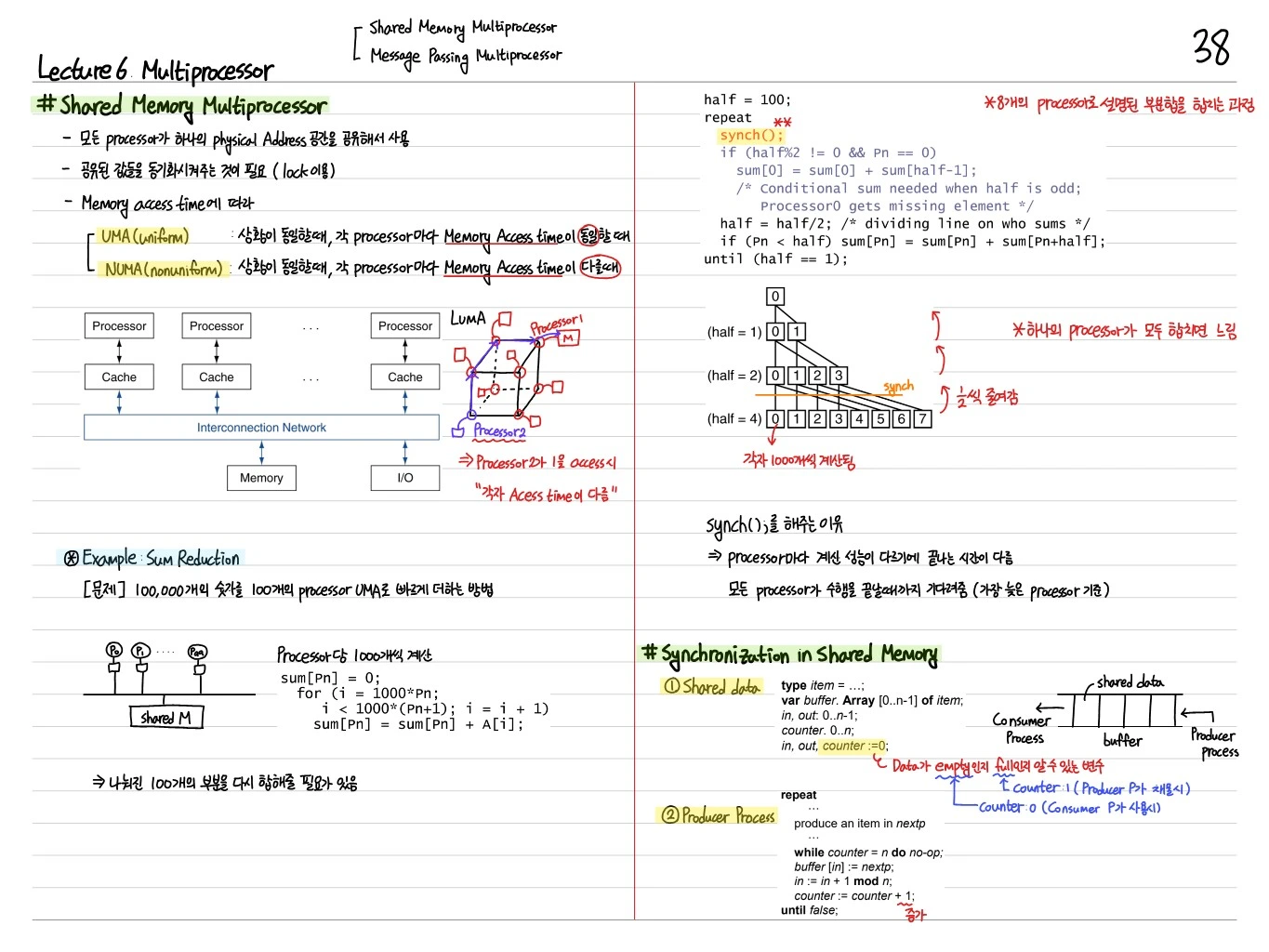
Shared Memory Multiprocessor
[P1]──[Cache]──┐
[P2]──[Cache]──┼──[Interconnection Network]──[Memory]
[P3]──[Cache]──┘
- UMA (Uniform Memory Access): 모든 프로세서가 메모리 접근 시간이 같음
- NUMA (Non-Uniform Memory Access): 프로세서에 가까운 메모리 접근은 빠르고, 먼 메모리 접근은 느림
- Memory access time도 다름
Example: Sum Reduction
100개의 프로세서가 100,000개 숫자를 합산하는 코드:
sum[Pn] = 0;
for (i = 10000*Pn; i < 10000*(Pn+1); i = i + 1)
    sum[Pn] = sum[Pn] + A[i];
/* now add the sub-sums */
half = 100;
repeat
    synch();
    if (half%2 != 0 && Pn == 0)
        sum[0] = sum[0] + sum[half-1];
    /* Conditional sum needed when half is odd */
    half = half/2;  /* dividing line on who sums */
    if (Pn < half)
        sum[Pn] = sum[Pn] + sum[Pn+half];
until (half == 1);
Synchronization이 필요한 이유: 여러 processor가 같은 변수를 동시에 읽고 쓸 때 race condition 발생.
Synchronization in Shared Memory
예: Producer-Consumer 문제
Shared data
int counter = 0;
int buffer[BUFFER_SIZE];
int in = 0; int out = 0;

/* Producer */
while (counter == BUFFER_SIZE) ;  // do nothing
buffer[in] = next_produced;
in = (in + 1) % BUFFER_SIZE;
counter++;

/* Consumer */
while (counter == 0) ;  // do nothing
next_consumed = buffer[out];
out = (out + 1) % BUFFER_SIZE;
counter--;
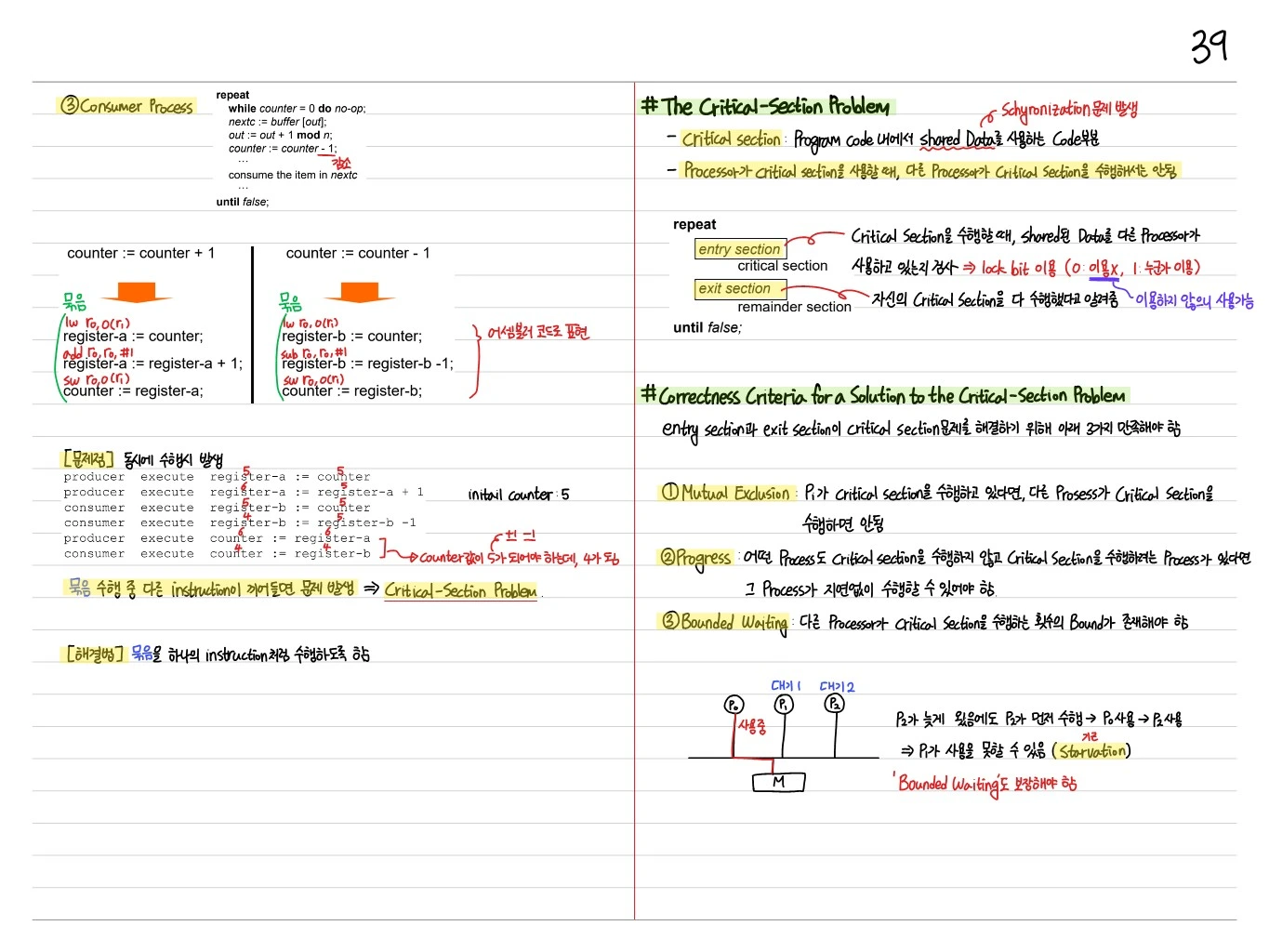
counter++와 counter--가 atomic하지 않으면 race condition 발생.
예: counter++ = register1 = counter; register1 = register1 + 1; counter = register1;
두 processor가 인터리빙되면 값이 손실될 수 있음 → Critical Section 문제.
The Critical-Section Problem
repeat
    Entry Section
       critical section  ← 한 번에 한 processor만 진입
    Exit Section
       remainder section
until false;
Correctness Criteria for a Solution
- Mutual Exclusion: 한 critical section은 한 processor만 진입
- Progress: critical section에 들어가려는 processor가 있으면 결국 들어갈 수 있음
- Bounded Waiting: Critical Section에 진입하려는 processor는 유한 시간 내에 진입해야 함 (starvation 방지)
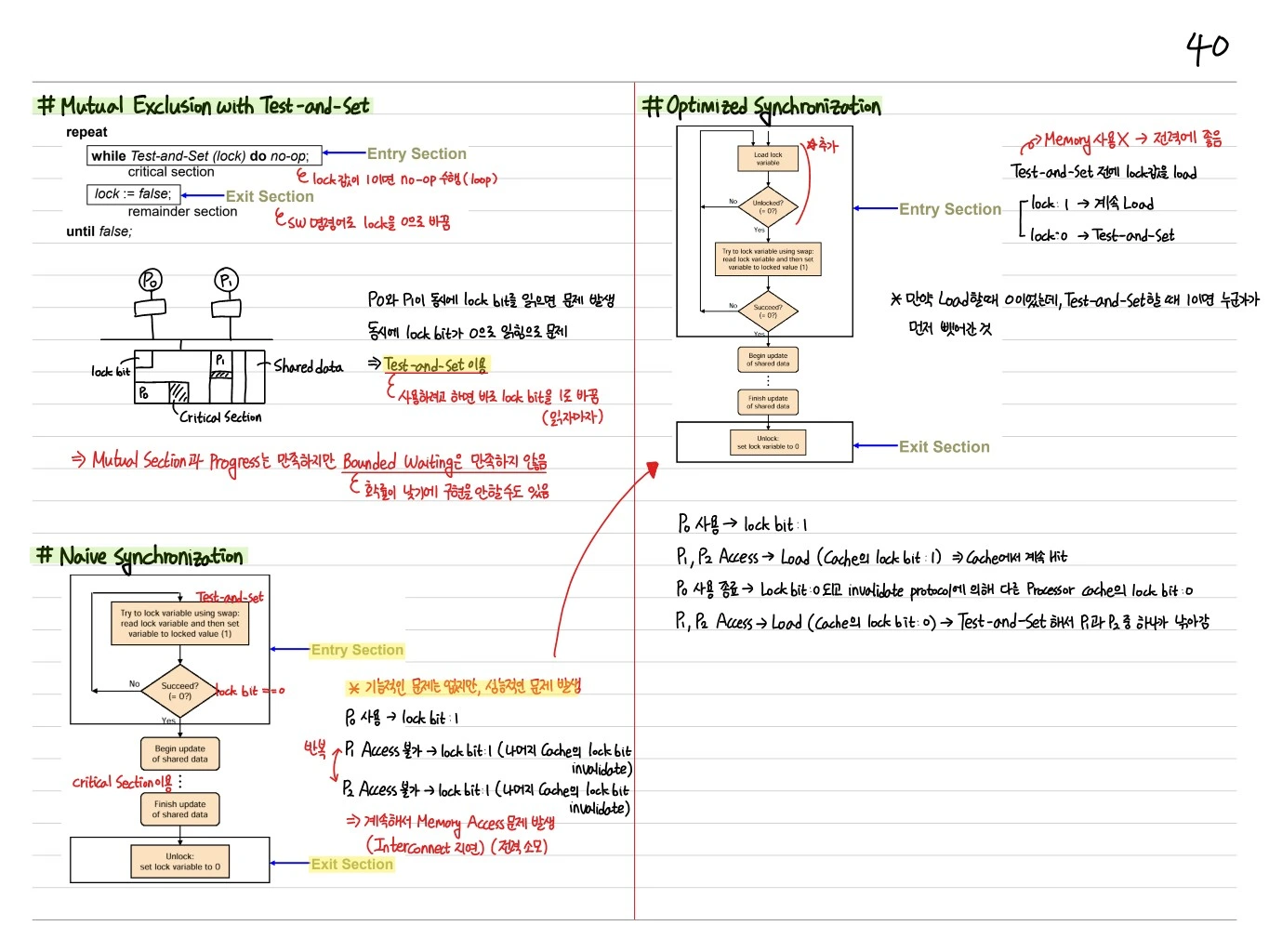
Mutual Exclusion with Test-and-Set
repeat
    while Test-and-Set(lock) do no-op;   // Entry Section
        critical section
    lock := false;                       // Exit Section
       remainder section
until false;
- Lock 값이 1이면 no-op 수행 (loop, busy-wait)
- SW 명령어로 lock을 0으로 바꿈
P0와 P1이 동시에 lock bit를 읽으면 문제 발생
동시에 lock bit가 0으로 읽히므로 문제. Test-and-Set은 atomic 연산으로 이를 방지 (사용하려고 하면 바로 lock bit를 1로 바꿈, 읽자마자).
→ Mutual Section과 Progress는 만족하지만 Bounded Waiting은 만족하지 않음 (확률이 낮기에 구현을 안할 수도 있음).
Naive Synchronization vs Optimized Synchronization
Naive (Test-and-Set in a loop)
Try to lock variable using swap:
    read lock variable and then set
    variable to locked value (1)

Succeed? (= 0?)
    Yes → Begin update, Finish update, Unlock (set lock variable to 0)
    No  → loop
기능적인 문제는 없지만, 성능적인 문제 발생:
- P0 사용 → lock bit: 1
- P1 Access 불가 → lock bit: 1 (나머지 Cache의 lock bit invalidate)
- P2 Access 불가 → lock bit: 1 (나머지 Cache의 lock bit invalidate)
→ 계속해서 Memory Access 문제 발생 (Interconnect 지연, 전력 소모).
Optimized Synchronization (Load-first)
- Memory 사용 X → 전력에 좋음
- Test-and-Set 전에 lock 값을 load
lock: 1→ 계속 Loadlock: 0→ Test-and-Set
만약 Load할 때 0이었는데 Test-and-Set할 때 1이면 누군가가 먼저 빼앗아간 것.
- P0 사용 → lock bit: 1
- P1, P2 Access → Load (Cache의 lock bit: 1) → Cache에서 계속 Hit (메모리 접근 X)
- P0 사용 종료 → Lock bit: 0되고 invalidate protocol에 의해 다른 Processor Cache의 lock bit: 0
- P1, P2 Access → Load (Cache의 lock bit: 0) → Test-and-Set해서 P1과 P2 중 하나가 낚아챔
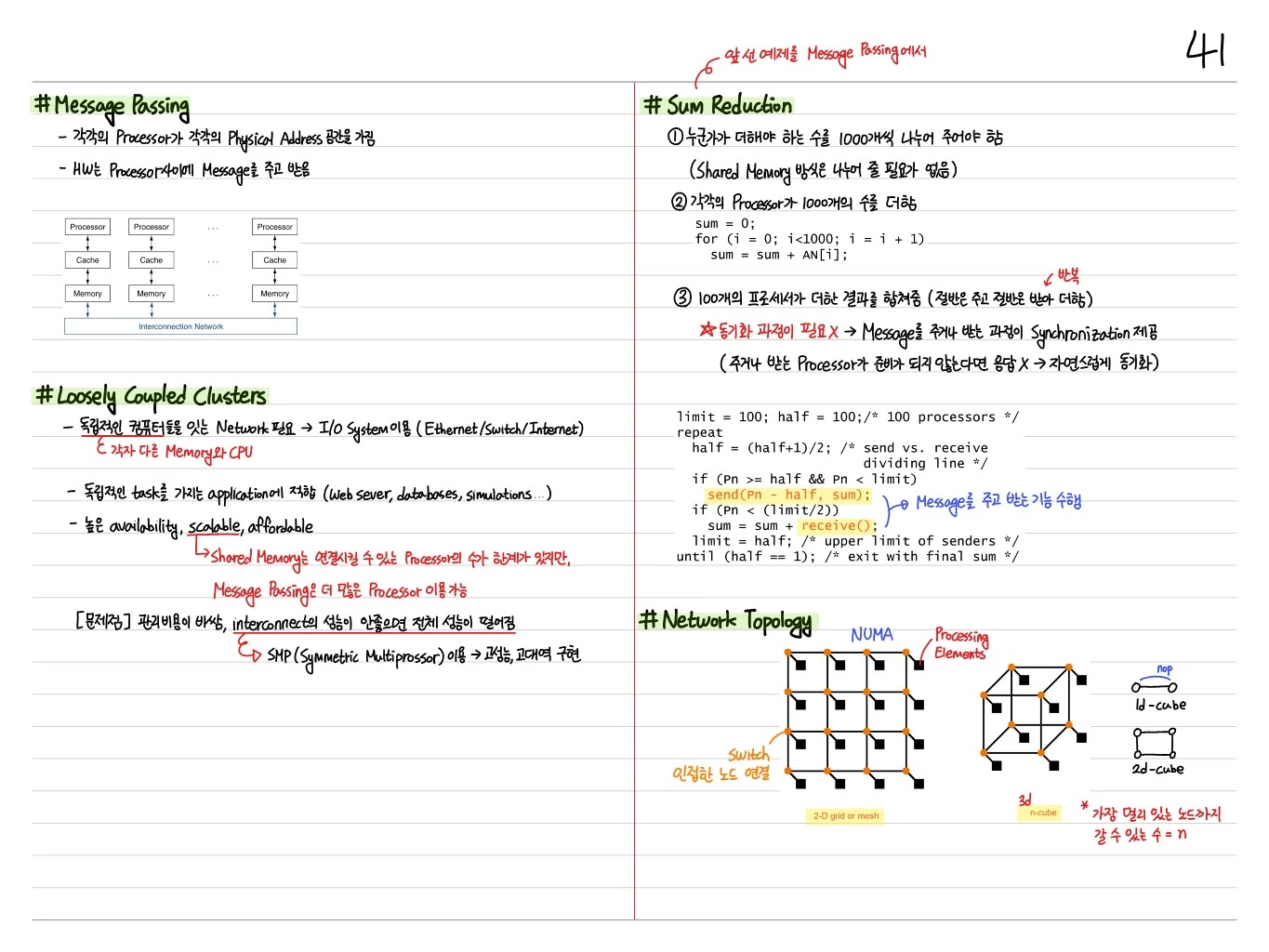
Message Passing
- 각각의 Processor가 각각의 Physical Address 공간을 가짐
- HW는 Processor 사이에 Message를 주고 받음
[Processor]─[Cache]─[Memory]  ...  [Processor]─[Cache]─[Memory]
          └──────── Interconnection Network ────────┘
Loosely Coupled Clusters
- 독립적인 컴퓨터들을 잇는 Network 필요 → I/O System 이용 (Ethernet/Switch/Internet)
- 각자 다른 Memory와 CPU
- 독립적인 task를 가지는 application에 적합 (Web server, databases, simulations …)
- 높은 Availability, Scalable, Affordable
→ Shared Memory는 연결시킬 수 있는 Processor의 수 한계가 있지만, Message Passing은 더 많은 Processor 이용 가능.
[문제점]: 관리 비용이 비싸고, Interconnect의 성능이 낮으면 전체 성능이 떨어짐 → SMP (Symmetric Multiprocessor) 이용 → 고성능, 고대역 구현.
Sum Reduction in Message Passing
- ① 누군가가 더해야 하는 수를 1000개씩 나누어 주어야 함 (Shared Memory 방식은 나누어 줄 필요 없음)
- ② 각각의 Processor가 1000개의 수를 더함
- ③ 100개의 프로세서가 더한 결과를 합쳐줌 (절반은 주고 절반은 받아 더함) — 반복
- 동기화 과정이 필요 X → Message를 주거나 받는 과정이 Synchronization 제공 (주거나 받는 Processor가 준비가 되지 않는다면 응답 X → 자연스럽게 동기화)
limit = 100; half = 100;  /* 100 processors */
repeat
    half = (half+1)/2;  /* send vs. receive dividing line */
    if (Pn >= half && Pn < limit)
        send(Pn - half, sum);
    if (Pn < (limit/2))
        sum = sum + receive();
    limit = half;  /* upper limit of senders */
until (half == 1);  /* exit with final sum */
Network Topology
NUMA Topology 예
[Switch]─[Switch]─[Switch]─[Switch]
   │        │        │        │
[Switch]─[Switch]─[Switch]─[Switch]
   │        │        │        │
  ...
2-D grid or mesh, 3-D n-cube (hypercube) 등.
- Processing Elements (PEs) 여러 개, Switch로 연결
- 가장 멀리 있는 노드까지 갈 수 있는 수 = $n$ (n-cube)
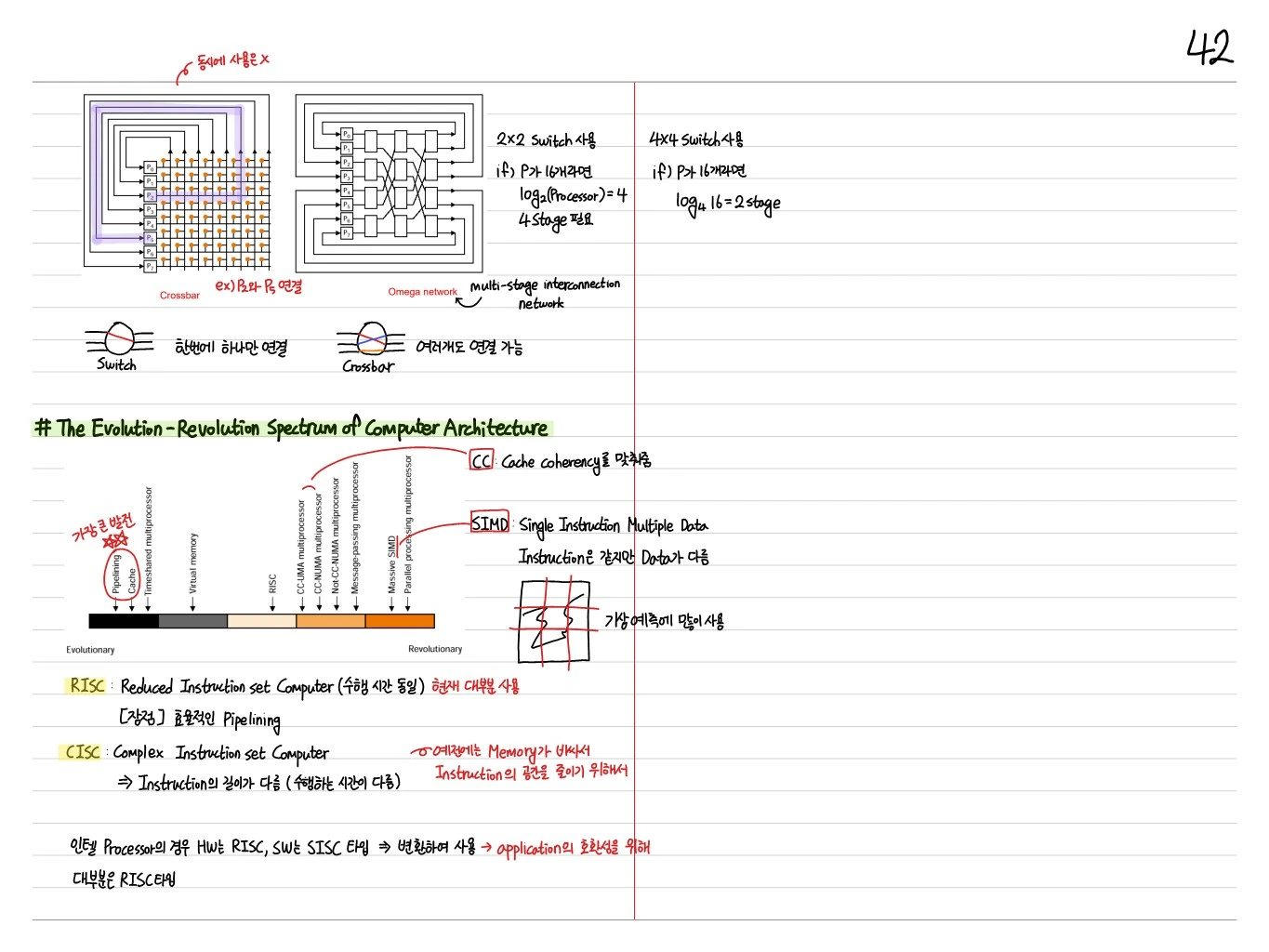
Crossbar & Multi-Stage Interconnection Network
Crossbar
동시에 여러 쌍 연결 가능. 예: P0와 P3 연결 가능.
Omega Network (Multi-stage interconnection network)
- 2×2 Switch 사용: If P가 16개라면 $\log_2(16) = 4$ → 4 stage 필요
- 4×4 Switch 사용: If P가 16개라면 $\log_4(16) = 2$ → 2 stage
Switch (한 쌍만 연결)
Crossbar (여러 쌍도 연결 가능)
The Evolution-Revolution Spectrum of Computer Architecture
Evolutionary ────────────────────────────→ Revolutionary
Pipelining → Cache → Timeshared → Virtual → RISC → CC-UMA → CC-NUMA → Not-CC-NUMA → Message-passing → Massive SIMD → Parallel processing
- 가장 큰 발전: Pipelining, Cache
- CC (Cache Coherency): Cache coherency를 맞춰줌
- SIMD: Single Instruction Multiple Data — Instruction은 같지만 Data가 다름 (가장 예측에 많이 사용)
RISC vs CISC
- RISC (Reduced Instruction Set Computer): 수행 시간 동일, 현재 대부분 사용. 장점: 효율적인 Pipelining.
- CISC (Complex Instruction Set Computer): Instruction의 길이가 다름 (수행하는 시간이 다름). 예전에는 Memory가 비싸서 Instruction의 공간을 줄이기 위해서.
→ Intel Processor의 경우 HW는 RISC, SW는 CISC 타입 → 변환하여 사용 → Application의 호환성을 위해. 대부분은 RISC 타입.
정리
| 개념 | 설명 |
|---|---|
| Shared Memory MP | 모든 processor가 같은 memory space 공유 (UMA/NUMA) |
| Message Passing MP | 각자의 memory, message로 통신 (cluster, HPC) |
| Cache Coherence | Multi-level cache 간 값 일치 유지 |
| Synchronization | Test-and-Set / Load-first로 atomic 연산 구현 |
| Network Topology | Crossbar, Omega, 2D-mesh, n-cube |
| SIMD | 한 명령어로 여러 데이터 동시 처리 (GPU의 기반) |
Multiprocessor는 이후 Multi-core CPU + GPU + Cluster로 이어지는 모든 병렬 컴퓨팅의 이론적 기반이 된다.
 Computer Architecture Note
 Embedded Note
 SoC Note
Comments (0)
No comments yet. Be the first to comment!
댓글을 쓰려면 하세요.