
2. Design Methodology
2장 Design Methodology 개요
SoC (System-on-Chip) 설계는 기존 ASIC과 달리 IP(Intellectual Property) 재사용, Design Methodology 선택, Full-custom부터 Programmable logic까지의 스펙트럼에 따라 달라진다. 이 장에서는 반도체 회로 설계 공정과 SoC 설계 방법론을 정리한다.
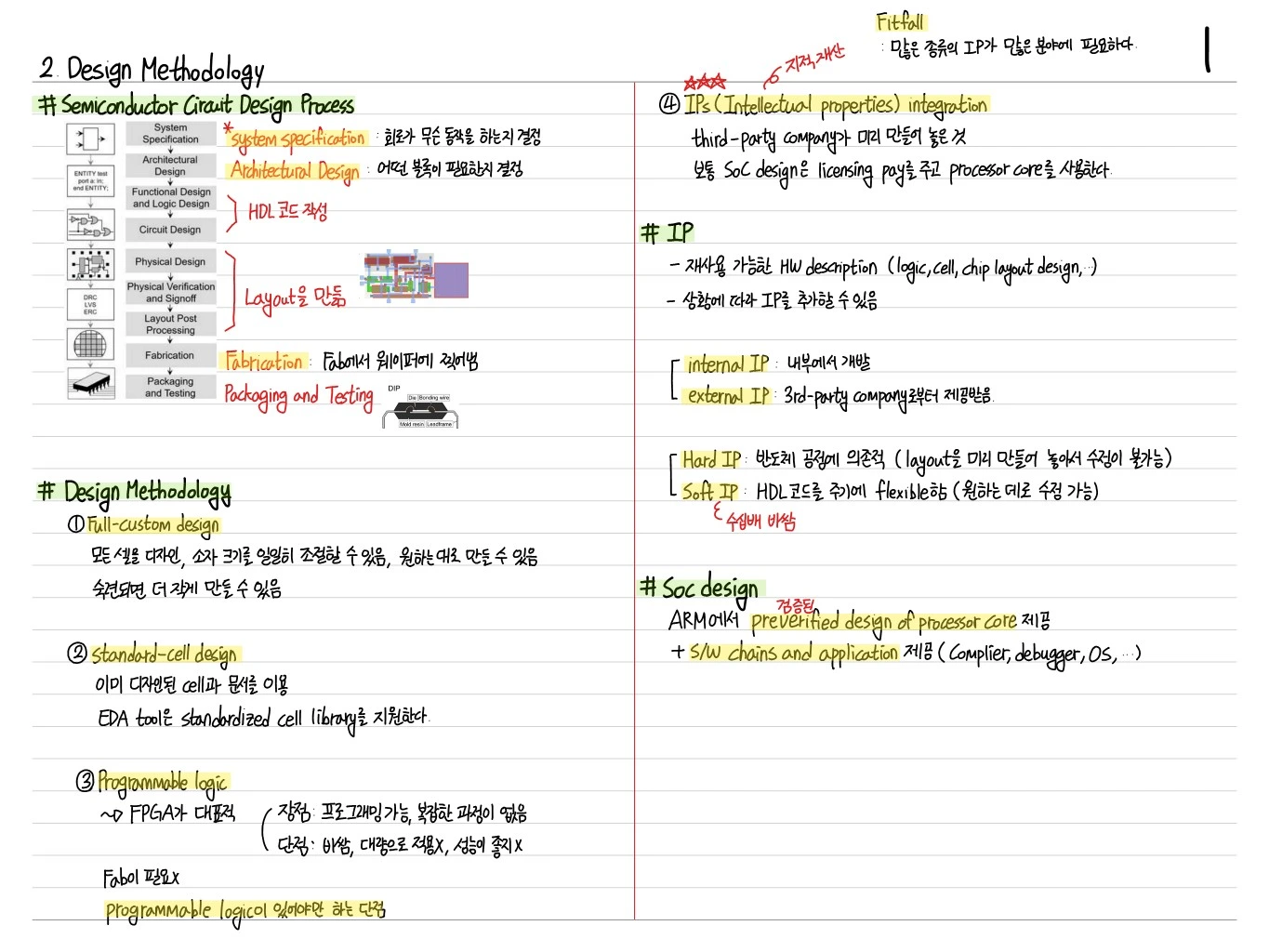
Semiconductor Circuit Design Process
반도체 회로 설계는 다음 단계로 진행:
- System Specification: 요구사항 정의 (목표 무엇을 할지)
- Architectural Design: 아키텍처/블록 수준 결정
- Functional Design and Logic Design: HDL(Verilog/VHDL) 코드 작성
- Circuit Design: 트랜지스터 레벨 설계
- Physical Design: Layout 결정 (면적, 배치)
- Physical Verification and Signoff: DRC, LVS, STA 검증
- Layout Post Processing: GDSII 변환
- Fabrication: Fab에서 웨이퍼 제조
- Packaging and Testing: 패키지, 테스트
Design Methodology
① Full-Custom Design
- 모든 셀의 대로(배치), 소자 크기를 일일이 조절할 수 있음 (원하는 대로 만들 수 있음)
- 숙련된 노력이 더 개시 만들 수 있음
- 면적/성능 최적 but 시간과 비용 매우 ↑
② Standard-Cell Design
- 이미 디자인된 cell을 블럭으로 이용
- EDA tool은 standardized cell library를 지원해줌
- 가장 일반적인 ASIC 설계 방식
③ Programmable Logic
- FPGA가 대표적
- 장점: 프로그래밍 가능, 빠른 시작점 얻음
- 단점: 비싼, 대용량 저장X, 성공 졸업X (면적/성능 ASIC보다 낮음)
- Fab이 필요 X
- Programmable logic이 일어 해프 쓰는 단점
Pitfall — 밑에서 출발하는 IP가 많은 분야에 필요하다
④ IPs (Intellectual Properties) Integration
- Third-party component을 이미 만들어진 걸 쓴 것
- 보통 SoC 설계는 licensing하여 processor core를 사용한다
IP (Intellectual Property)
- 재사용을 가능한 HW description (logic, cell, chip layout design 등)
- 상품에 대한 IP로도 추가할 수 있음
Internal IP
- 내부에서 개발
External IP
- 3rd-party component로서 제공받음
Hard IP
- 반도체 공정에 의존적 (layout도 만들어 놓아서 수정이 불가능)
Soft IP
- HDL 코드로 주어지 flexible함 (원하는 대로 수정 가능)
SoC Design
공급업체 ARM에서 pre-verified design of processor core 지원 + S/W chains and application 제공 (Compiler, debugger, OS, ...)
정리
| 항목 | 설명 |
|---|---|
| Full-custom | 모든 소자 직접 설계. 면적/성능 최고. 비용 ↑ |
| Standard-cell | Cell library 조합. 가장 일반적 |
| Programmable (FPGA) | 빠른 검증. 면적/성능 낮음 |
| IP 기반 SoC | Third-party core (ARM Cortex 등) + 자체 IP 조합 |
| Hard IP vs Soft IP | Layout 고정 vs HDL 수정 가능 |
SoC 설계의 본질은 "IP를 어떻게 재사용할 것인가". ARM의 Cortex 시리즈가 SoC 시장의 표준이 된 이유는 잘 검증된 soft IP + Compiler/OS 스택을 한 번에 제공하기 때문이다.
 SoC Note
 AI Study Note
 Embedded Note
Comments (0)
No comments yet. Be the first to comment!
Please to write a comment.