
3. Memory Herachy
3장 Memory Hierarchy 개요
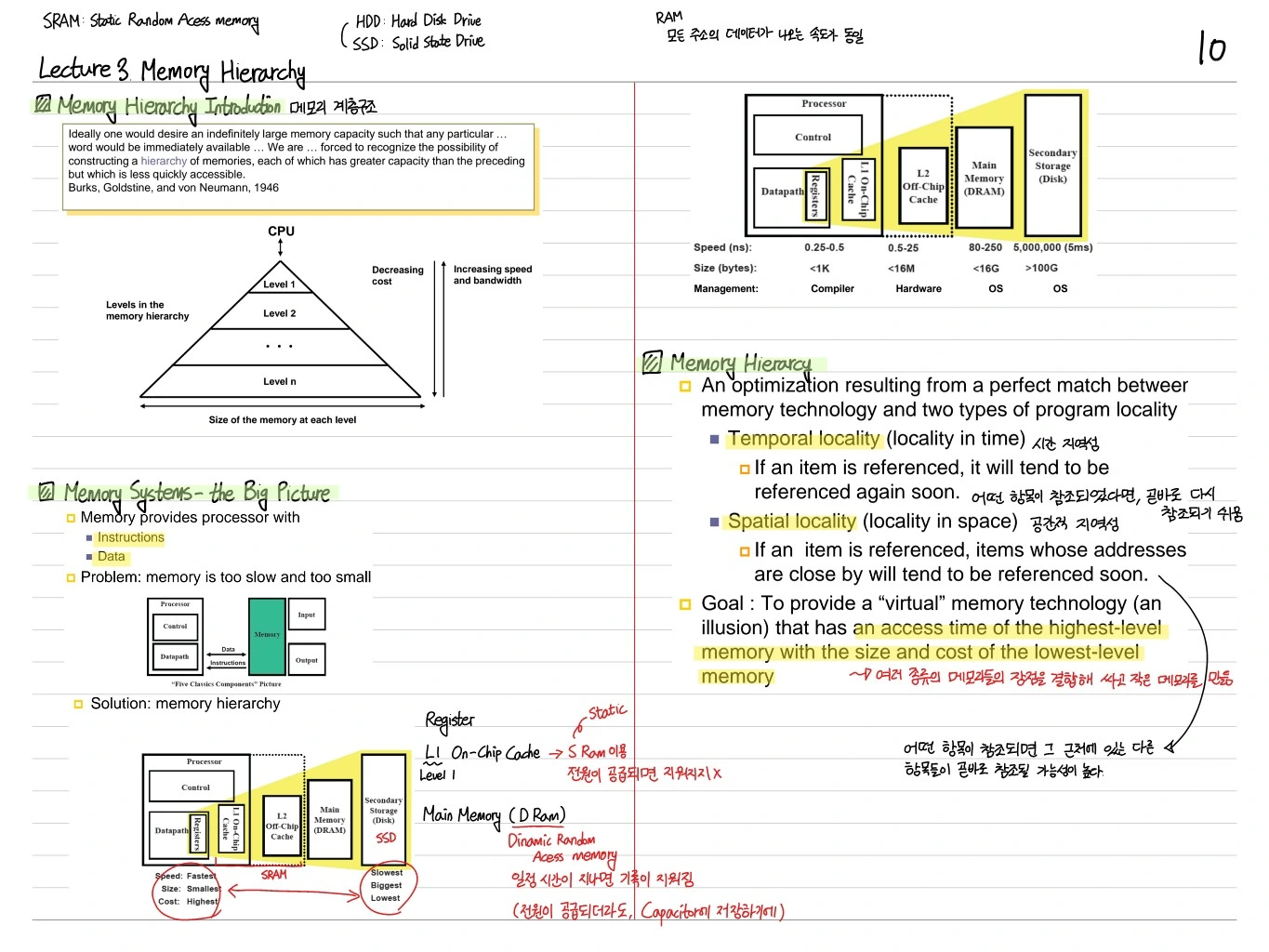
Memory Hierarchy는 "가장 빠른 메모리의 속도 + 가장 큰 메모리의 용량"이라는 가상 메모리 환상(illusion)을 만들기 위한 핵심 최적화. Program locality(Temporal & Spatial)를 활용해 작은 고속 메모리와 큰 저속 메모리를 조합한다.
Memory Hierarchy: Solution to Memory Wall
메모리 시스템의 Big Picture
- Memory: Stores programs and data
- Problem: Memory is too slow and too small compared to CPU
       (fast, small, expensive)
            [ Register ]
              [ L1 $ ]
             [   L2 $   ]
           [  Main memory  ]
         [      Disk       ]
       [       Tape (slow, huge, cheap)     ]
- Speed: sub-ns → ms
- Size: 1 KB → TB
Memory Hierarchy의 정의
An optimization resulting from a perfect match between memory technology and two types of program locality.
- Temporal locality: 시간적 지역성. 한 번 참조된 데이터는 곧 다시 참조될 가능성이 높음
- Spatial locality: 공간적 지역성. 한 데이터에 접근하면 그 근처의 데이터도 곧 참조됨
Goal: Provide a "virtual" memory technology (illusion) that has an access time of the highest-level memory with the size and cost of the lowest-level memory.
Memory Hierarchy Terminology
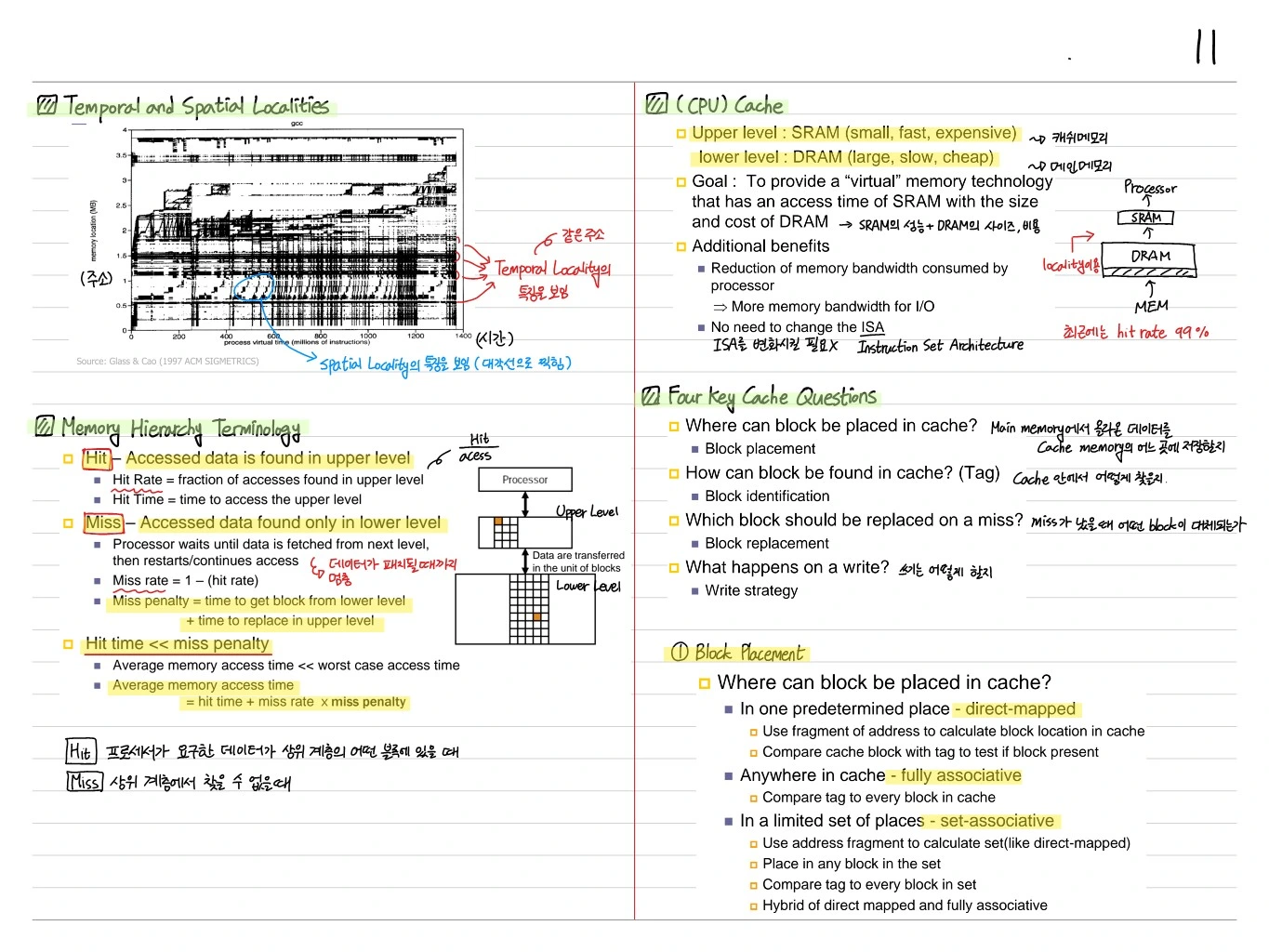
- Hit: Accessed data is found in upper level (상위 레벨에 있음 — 성공)
- Miss: 상위 레벨에 없음, 아래 레벨에서 가져와야 함
- Hit time: 상위 레벨 access 시간
- Miss penalty: Miss 발생 시 아래 레벨에서 가져오는 추가 시간
- Hit ratio (Hit rate): $\frac{\text{Hits}}{\text{Accesses}}$, Miss ratio = 1 - Hit ratio
- Average memory access time (AMAT):
$$\text{AMAT} = \text{Hit time} + \text{Miss rate} \times \text{Miss penalty}$$
L0/L1 Cache 개요
- Upper level: SRAM (fast, expensive)
- Lower level: DRAM (large, slow, cheap)
- Goal: To provide a "virtual" memory technology
- Additional benefits:
- Reduction of memory bandwidth consumed by processor
- More memory bandwidth to I/O
- No need to change the ISA
- CPU 입장에서는 하나의 큰 메모리로 보인다 (Illusion)
Four Big Cache Questions
- Q1: Where can block be placed in cache? → Block placement
- Q2: How can block be found in cache? → Block identification
- Q3: Which block should be replaced on a miss? → Block replacement
- Q4: What happens on a write? → Write strategy
Block Placement — 3가지 방식
- Direct-mapped: 각 block이 캐시의 한 자리에만 올 수 있음. $$\text{Cache index} = \text{Block address} \bmod \text{Cache block 수}$$
- Fully associative: 어느 자리든 가능 (모든 slot 검색 필요)
- Set associative: 중간. 여러 set로 나뉘고 set 내에서는 fully associative. N-way set associative.
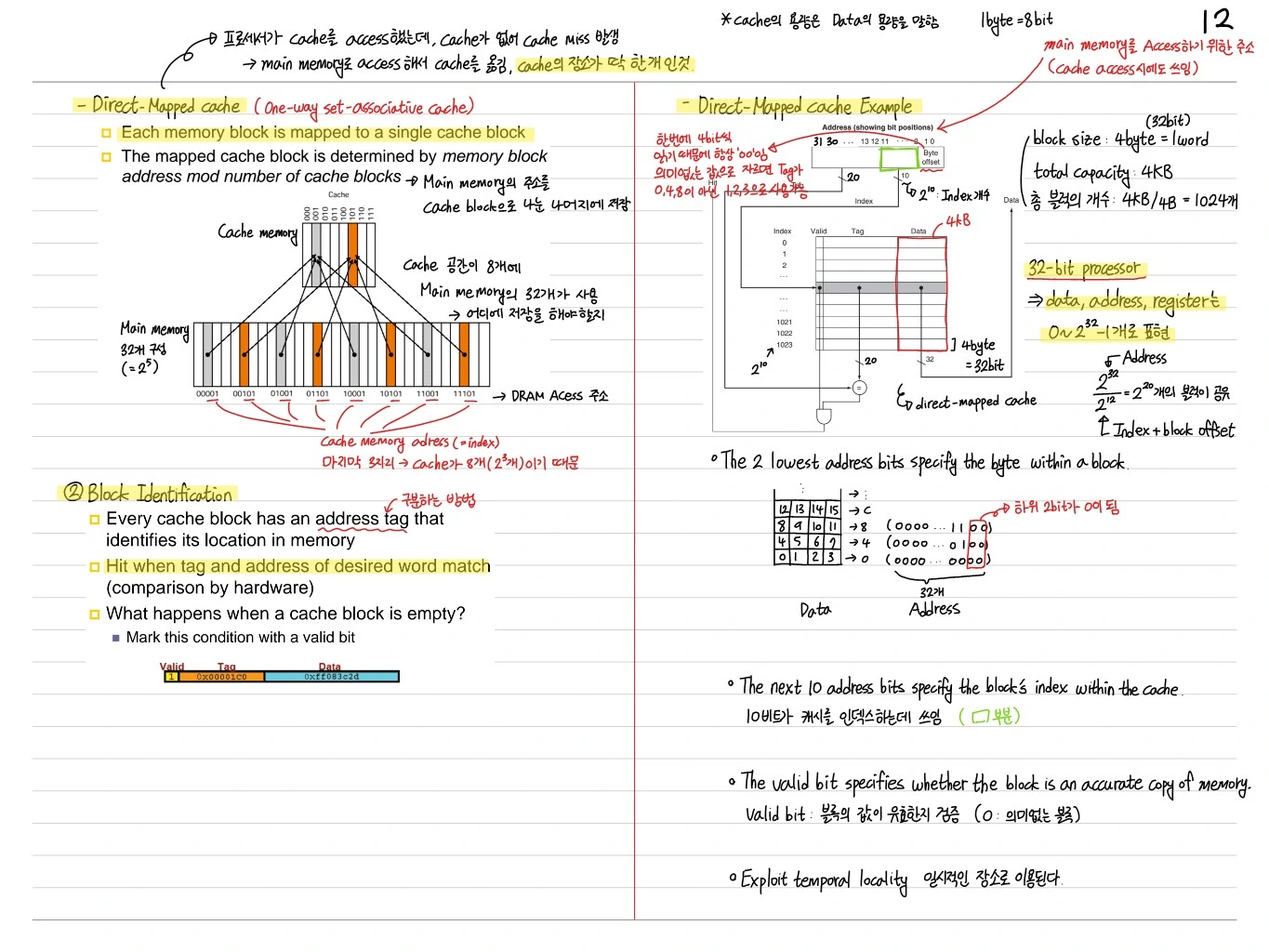
Direct-Mapped Cache 상세
- Each memory block is mapped to a single block in cache
- Mapped cache block is determined by memory block address $\bmod$ number of blocks in cache
- Cache index: Block # (bit address)
- 결과 비교: tag와 block number로 hit/miss 판단 + valid bit
Block Identification
- Every cache block has an address tag that identifies its location in memory
- Hit when tag and valid bits match + Miss otherwise
- What happens when a cache block is empty? → Mark this condition with a valid bit (0 = empty)
Direct-Mapped Cache 예제
16B block, 8 cache blocks, 5-bit index, 3-bit offset. Memory에서 Cache block index로 접근 → tag 비교 → Hit/Miss 판정.
Step by step:
- Address decoding:
[tag | index | offset] - Block address = Memory address / Block size
- Cache index = Block address mod Cache blocks
- Miss ratio는 temporal/spatial locality에 따라 달라짐
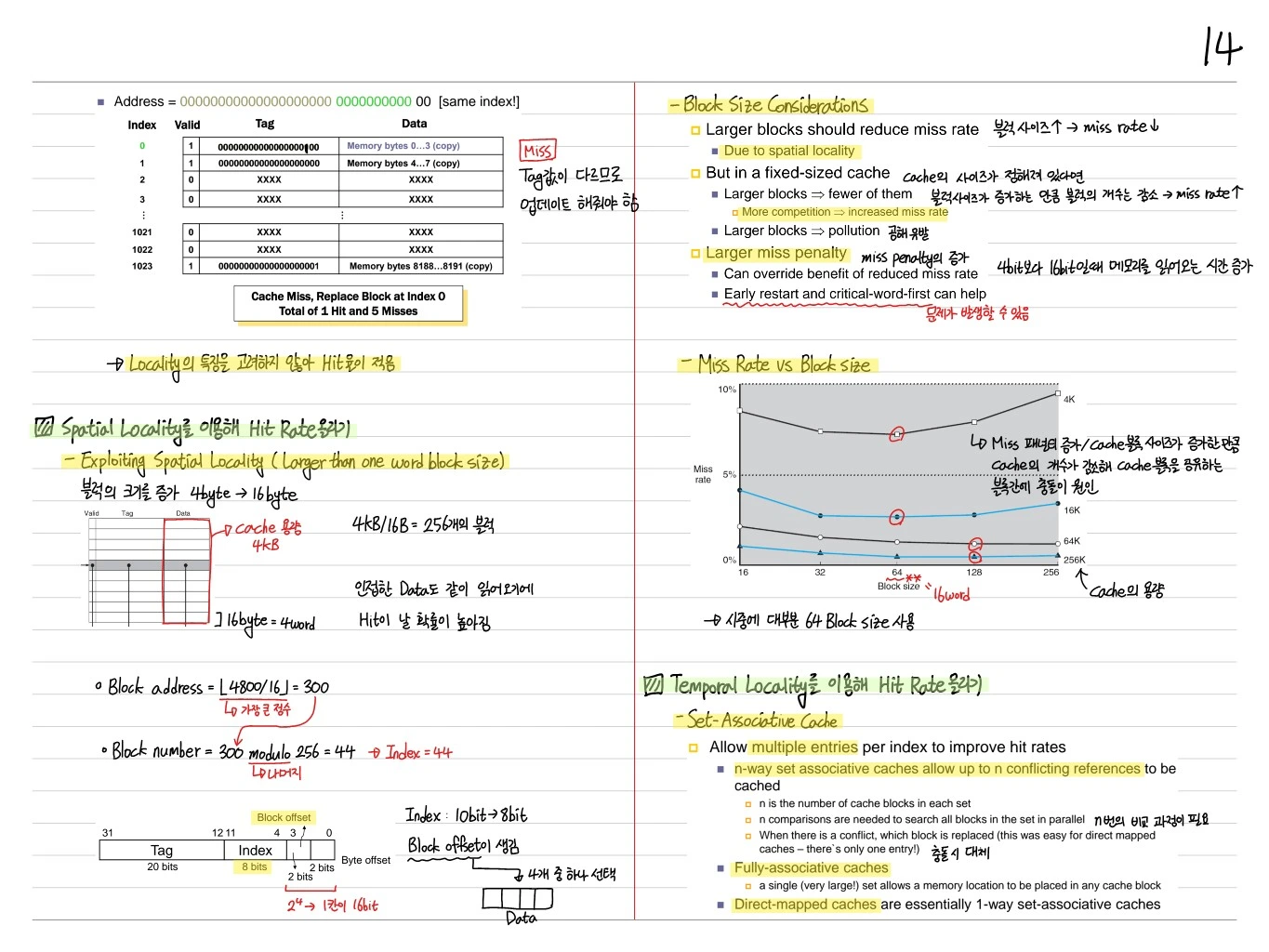
Block Size Considerations
- Larger blocks: spatial locality 활용 감소, but latency 증가
- But in a fixed-size cache:
- Larger blocks → fewer of them → more competition → miss rate 증가
- Larger blocks → pollution (cache에 안 쓰이는 데이터가 들어옴)
- Larger miss penalty → can override benefit of reduced miss rate
- Early restart and critical-word-first can help
Miss rate vs Block size
- 너무 작으면 spatial locality 활용 부족
- 너무 크면 cache 오염 + miss penalty 증가
- 중간 값이 optimal (보통 32~128B)
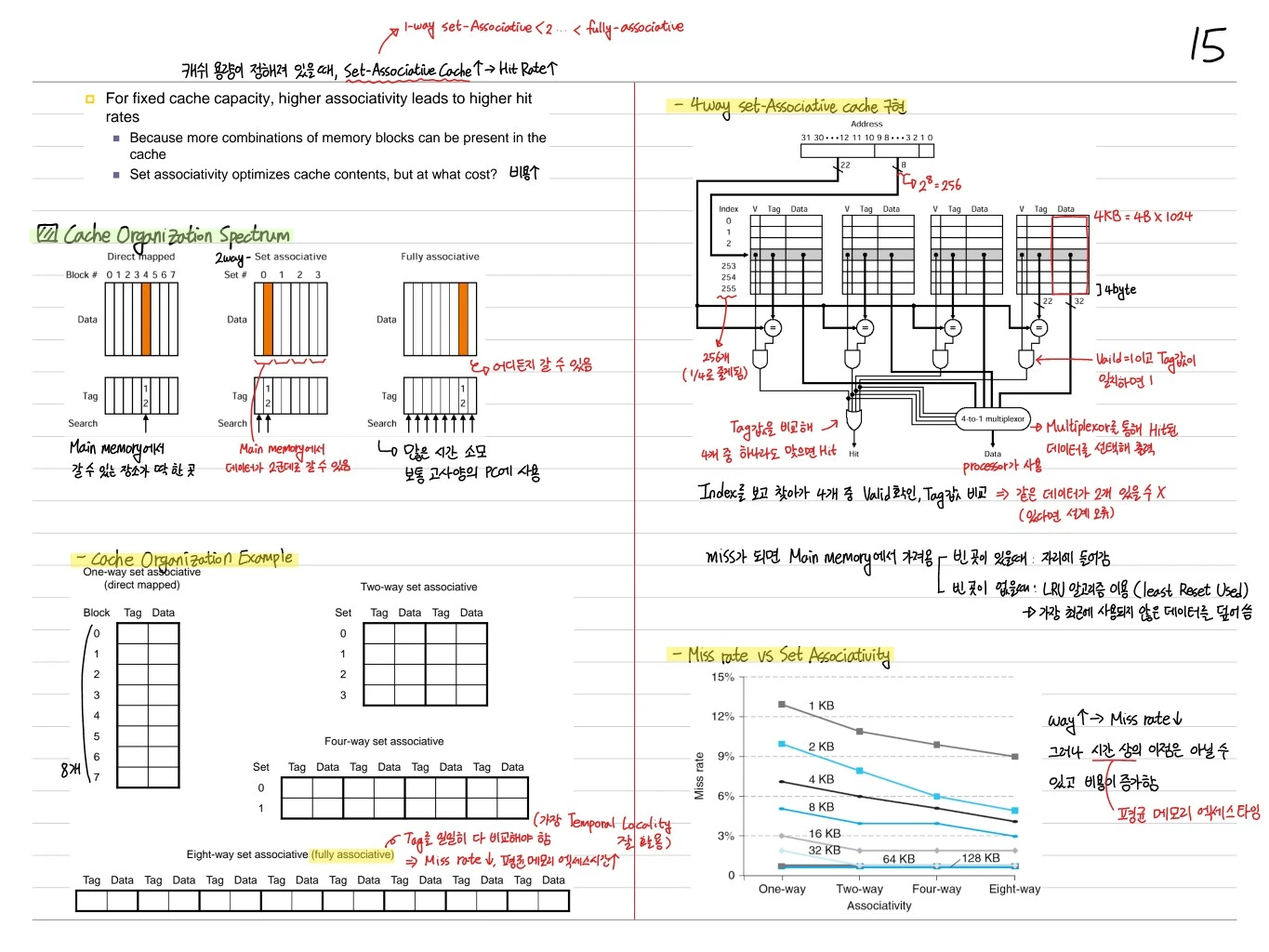
Cache Organization Spectrum
Direct-mapped vs Fully associative vs Set-associative
- Set-associative cache: 미리 정해진 set 안에서는 fully associative
- Four-way set associative: 4개 set × N blocks
- For fixed cache capacity, higher associativity tends to higher hit rate
Set-Associative Cache 구성
- Index → Set 선택 → Set 내 tag 비교 (fully associative)
- 4-way의 경우 동일 index로 4개 tag와 병렬 비교
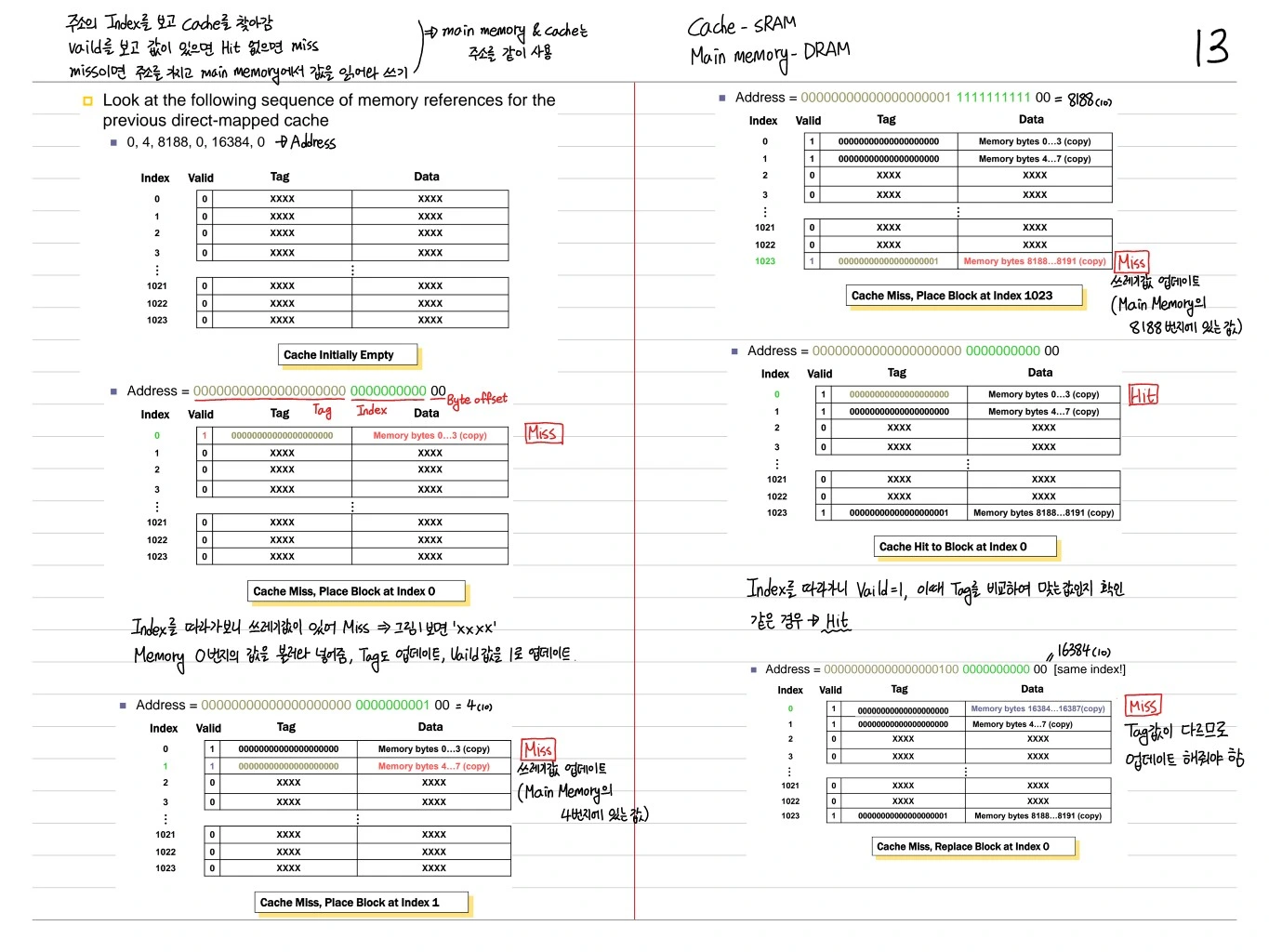
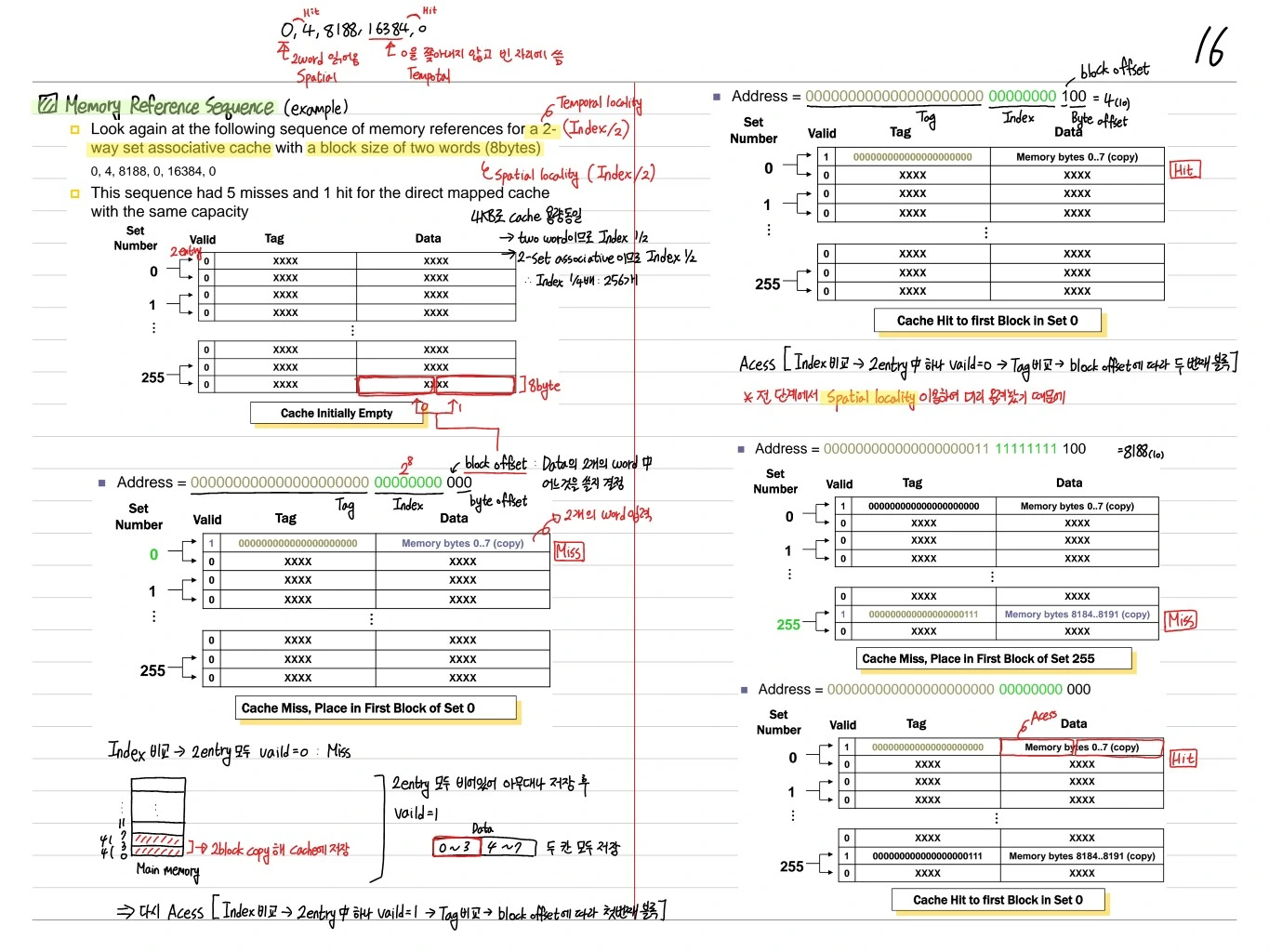
Memory Reference Sequence 예제
Cache initially empty, 1 hit for the third memory reference with the same capacity.
Step by step access pattern을 추적하며 각 cache의 hit/miss 카운트를 비교. Set-associative가 direct-mapped보다 hit 많음.
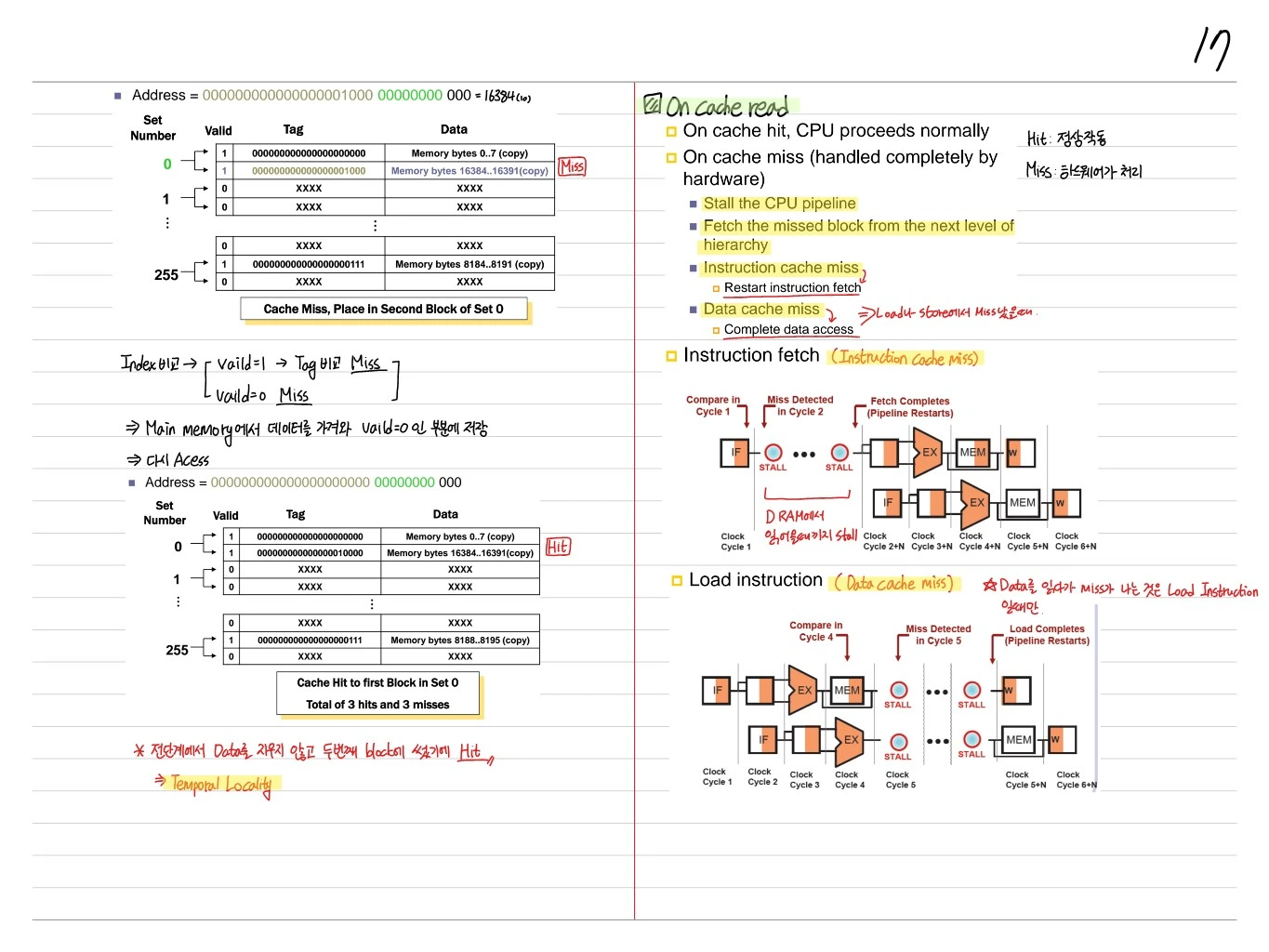
Cache Read 동작
On cache hit
CPU proceeds normally — 정상 작동.
On cache miss (handled completely by hardware)
- Stall the CPU pipeline
- Fetch the missed block from the next level of hierarchy
- Instruction cache miss → Restart instruction fetch
- Data cache miss → Complete data access
Instruction Fetch Flow (Instruction Cache Miss)
Clock Cycle 1에서 Compare, Cycle 2에서 Miss detected → Stall → Fetch completes → Pipeline restart. DRAM에서 읽어올 때까지 Stall.
Load Instruction Flow (Data Cache Miss)
Data를 읽다가 miss가 나는 것은 Load instruction일 때만. Cycle 4에서 compare, Cycle 5에서 miss detected → Stall → Load completes → Pipeline restart.
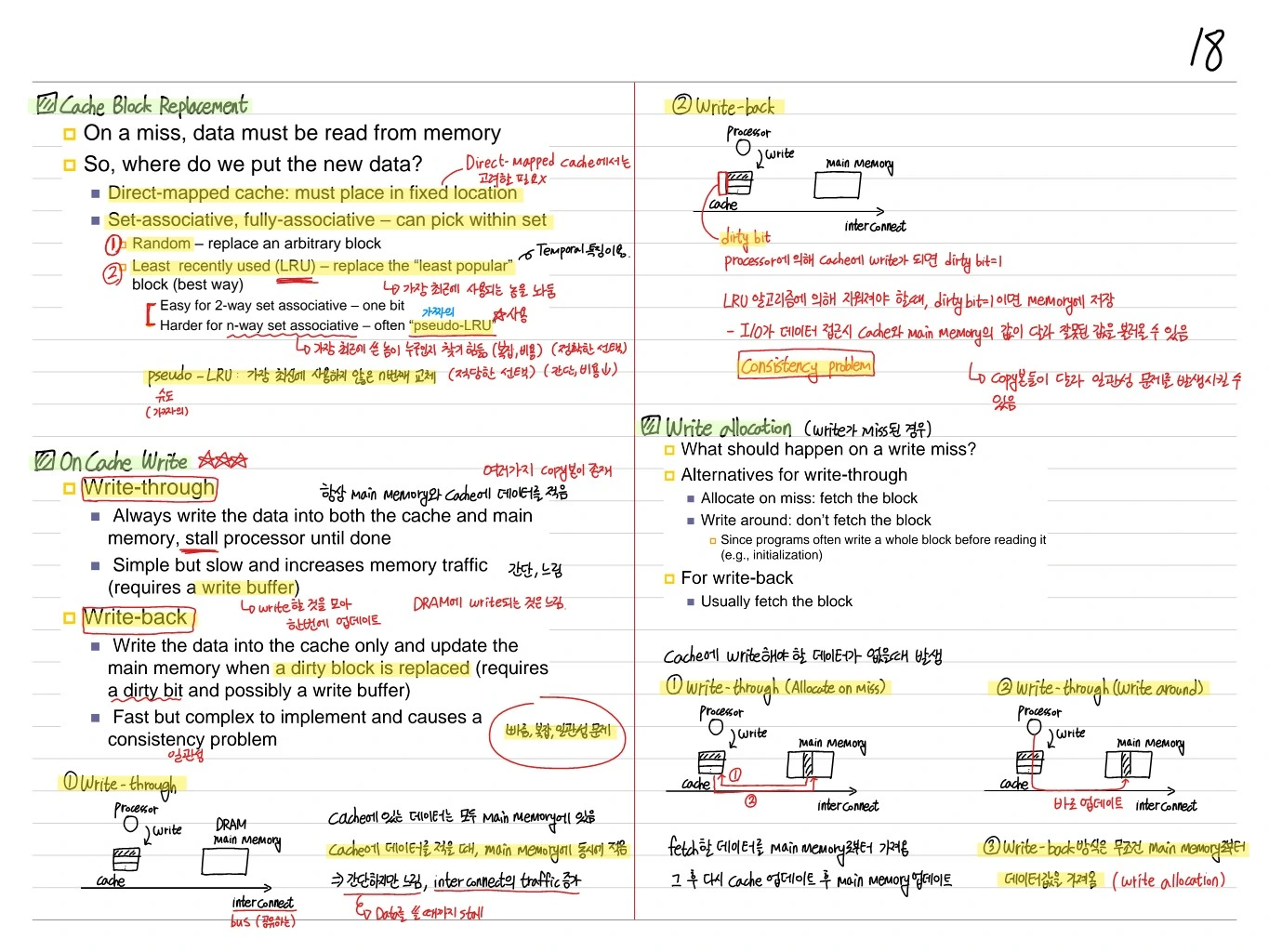
Cache Write 전략
Write-Through
- Always write the data into both the cache and main memory
- Simple but slow — increases memory traffic
- Needs a write buffer (주메모리 쓰기를 비동기로)
Write-Back
- Write the data into the cache only
- Update the main memory when a dirty block is replaced
- Requires a dirty bit (변경 여부 표시)
- Fast but complex to implement and causes a consistency problem
Write Miss Handling
- Write-allocate: Miss 시 block을 캐시에 올리고 write
- No-write-allocate: Miss 시 바로 메모리에만 write (cache 건드리지 X)
일반적으로 Write-back은 Write-allocate, Write-through는 No-write-allocate와 조합.
Cache Performance
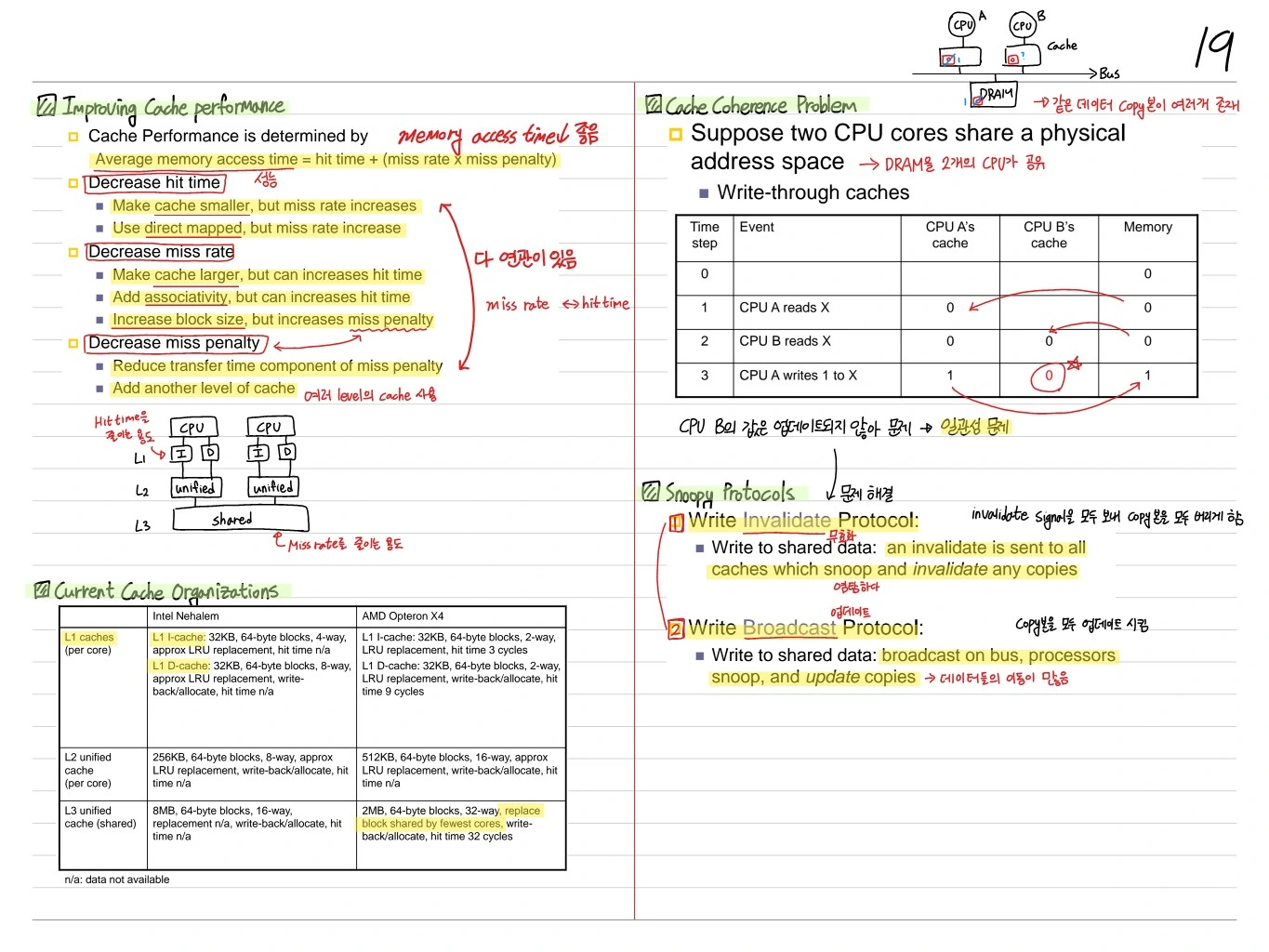
AMAT
$$\text{AMAT} = \text{Hit time} + \text{Miss rate} \times \text{Miss penalty}$$
$$\text{Average memory access time} = \frac{1}{N} \sum (\text{hit time} + \text{miss rate} \times \text{miss penalty})$$
Improving Cache Performance
- Decrease hit time: Small & direct-mapped cache
- Decrease miss rate: Bigger cache, more associativity
- Decrease miss penalty: Multi-level cache, critical-word first, prefetching
Current Cache Organizations
| Level | Cache size | Access time | Associativity |
|---|---|---|---|
| L1 D-cache | 32 KB | 1 cycle | 4-way |
| L1 I-cache | 32 KB | 1 cycle | 4-way |
| L2 | 256 KB | 10 cycles | 8-way |
| L3 | 8 MB | 30 cycles | 16-way |
| Main memory | GB | 100+ cycles | - |
Cache Coherence Problem
Suppose two CPU cores share a physical address space.
Write-through caches 예시:
| Time step | Event | CPU A''s cache | CPU B''s cache | Memory |
|---|---|---|---|---|
| 0 | - | - | - | 0 |
| 1 | CPU A reads X | 0 | - | 0 |
| 2 | CPU A writes 1 to X | 1 | - | 1 |
| 3 | CPU B reads X | 1 | 0 | 1 |
→ CPU B의 캐시가 stale(0) → coherence problem.
Snoopy Protocol
- Write-Broadcast: Write to shared data → an invalidate is sent to all other caches
- Write-Invalidate: Write to shared data → broadcast on bus, processors snoop and update copies
Write Invalidate Protocol 상세
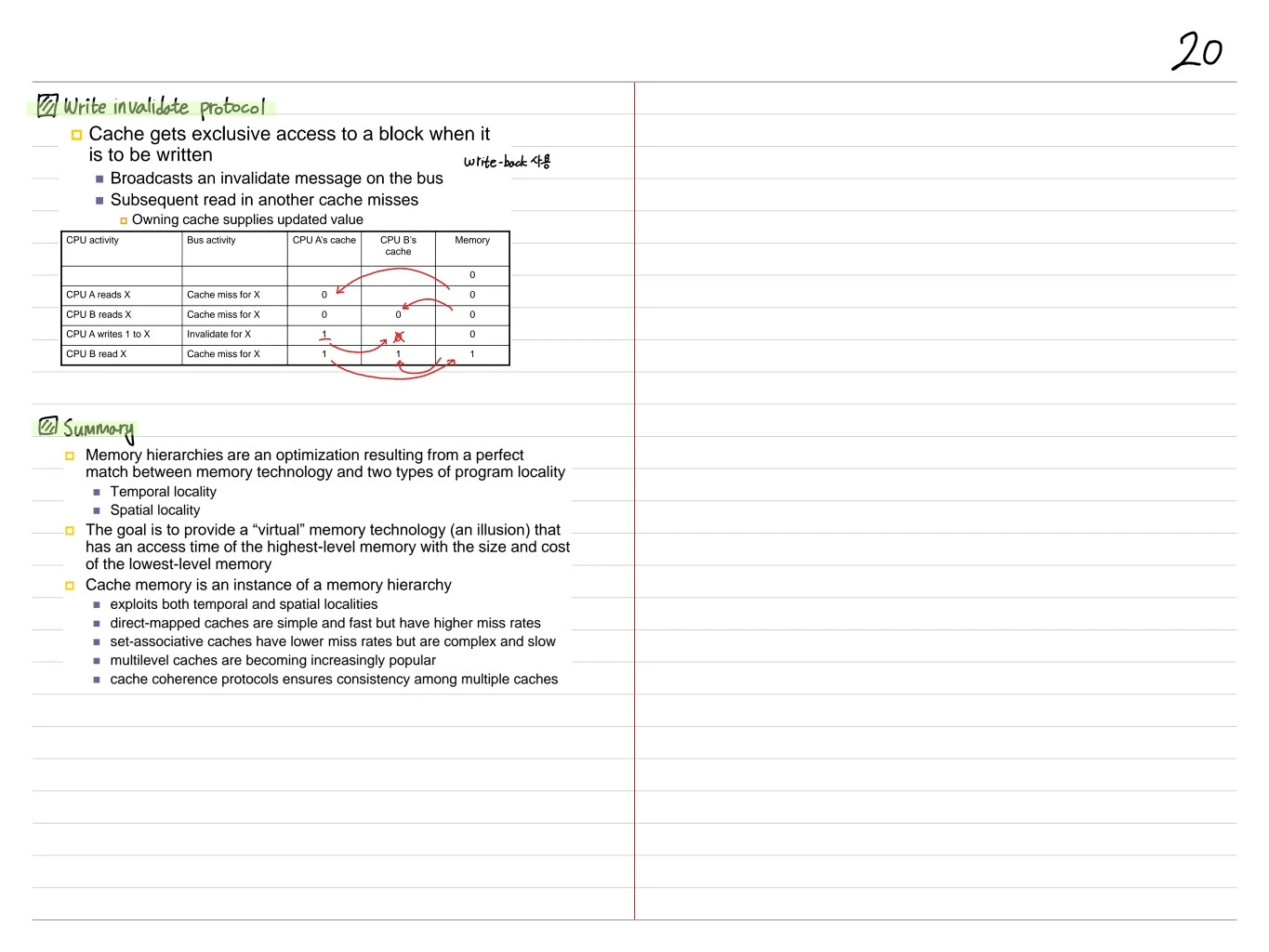
Cache gets exclusive access to a block when it is to be written:
- Broadcasts an invalidate message on the bus
- Subsequent read in another cache misses → Owning cache supplies updated value
예시 시나리오 (Write-back 사용):
| CPU activity | Bus activity | CPU A''s cache | CPU B''s cache | Memory |
|---|---|---|---|---|
| - | - | - | - | 0 |
| CPU A reads X | Cache miss for X | 0 | - | 0 |
| CPU B reads X | Cache miss for X | 0 | 0 | 0 |
| CPU A writes 1 to X | Invalidate for X | 1 | X (invalid) | 0 |
| CPU B reads X | Cache miss for X | 1 | 1 | 1 |
→ Owning cache (A)가 최신 값을 supply.
정리
- Memory hierarchies are an optimization resulting from a perfect match between memory technology and two types of program locality
- Temporal locality / Spatial locality
- The goal is to provide a "virtual" memory technology (illusion) that has an access time of the highest-level memory with the size and cost of the lowest-level memory
- Cache memory is an instance of a memory hierarchy
- Exploits both temporal and spatial localities
- Direct-mapped caches are simple and fast but have higher miss rates
- Set-associative caches have lower miss rates but are complex and slow
- Multilevel caches are becoming increasingly popular
- Cache coherence protocols ensure consistency among multiple caches
Computer Architecture Note의 다른 글
 Computer Architecture Note
1. Introduction
Instraction Set Architecture
 Computer Architecture Note
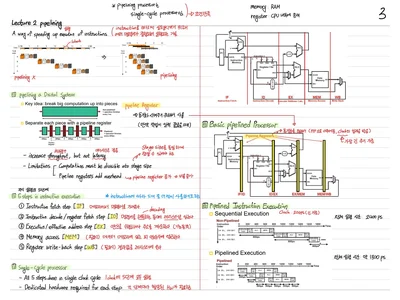
2. Pipelining
5-stage Pipeline Processor, Hazard, Prediction
 Computer Architecture Note
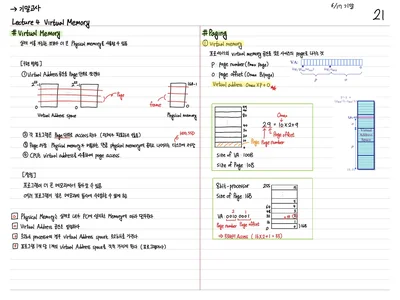
4. Virtual Memory
Paging, Page Table, TLB
 Computer Architecture Note
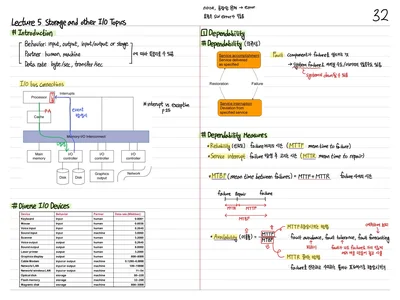
5. Storage and other I/O
Dependability, Register Map, Polling, Interrupt, DMA, RAID
 AI Study Note
 Embedded Note
 SoC Note
Comments (0)
No comments yet. Be the first to comment!
Please to write a comment.